
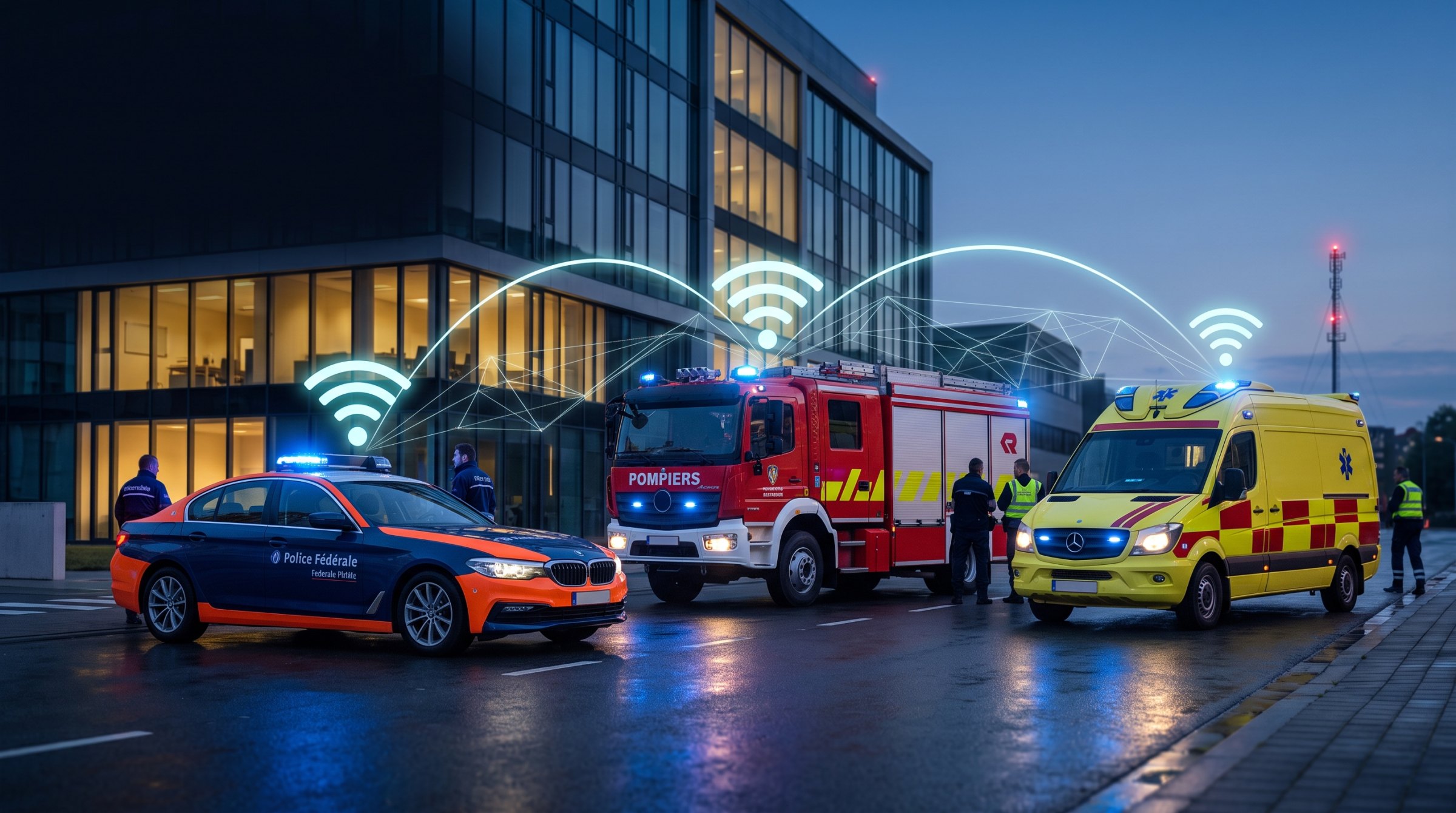
What does ASTRID stand for? The history behind our emergency services' network
Roel De Frene
Everyone in the security sector knows ASTRID. But few people know what the name actually stands for, why the network was created, and which events made its necessity painfully clear. Time to explain it clearly — because behind those five letters lies a story of cooperation, safety and communication that must never fail.
What does ASTRID stand for?
ASTRID is an acronym. In full, it stands for:
All-round Semi-cellular Trunking Radio communication system with Integrated Dispatchings
In plain language, ASTRID is the secure radio network that allows police, fire services, ambulance services and other emergency and security services in Belgium to communicate with each other. One network, for everyone who safeguards our safety.
Today, ASTRID serves some 750 different organisations: all police zones, all fire brigades and most of the country's emergency and security services. The network provides four core services: radio communication, paging, dispatching solutions and a mobile voice and data offering.
Why was ASTRID created?
ASTRID was established in 1998, pursuant to the law of 8 June 1998, as a public-law limited company on the initiative of the federal and local authorities. The goal was as simple as it was essential: to build one shared communication network for all emergency and security services.
Because that was where the problem lay. Before ASTRID, each service worked with its own radio system: the police had theirs, the fire service another, the medical services yet another. These systems were incompatible with each other. In practice: during a major intervention, a firefighter and a police officer standing side by side simply could not reach each other by radio. Each on their own channel, on their own island.
At the moment cooperation matters most — during a disaster — the services that had to act together could not hear each other.
The Heysel disaster: a painful lesson about communication
How crucial — and how deficient — that mutual communication was became tragically clear in our country during disasters such as the Heysel disaster of 1985. On 29 May of that year, 39 people lost their lives in rioting before the European Cup final at the Heysel Stadium.
In those kinds of large-scale emergencies, the same thing became apparent each time: the emergency services that had to work shoulder to shoulder could not communicate smoothly with one another. Different radio systems, no shared channels, no integrated coordination. It is precisely that kind of fragmentation that a modern, shared network like ASTRID was meant to eliminate from 1998 onwards.
An important nuance: ASTRID was not created "because of" one specific disaster. But events like the Heysel disaster do sharply illustrate why a shared, reliable communication network for emergency services is not a luxury, but a necessity.
22 March 2016: the lesson that repeated itself
That the communication of emergency services is crucial — and vulnerable — became clear again on 22 March 2016, during the attacks in Zaventem and the Brussels metro station Maalbeek. In the chaos that followed, the commercial mobile networks became completely saturated: due to the enormous spike in calls, ordinary mobile phones could barely connect.
It is precisely at such a moment that the communication of emergency services must not fail. That event underscored the importance of priority, guaranteed communication for those who must manage the emergency. For this, ASTRID offers, among other things, Blue Light Mobile: a service that gives emergency services, via a single SIM card, priority access to the three Belgian mobile networks — even during extreme saturation of the public network.
The common thread: coverage that must never fail
From 1985 to today, one common thread runs through this story: when it matters, the communication of emergency services must work. Always. Everywhere. Including in the places where a signal is hardest to reach.
And that is exactly where today's challenge lies. The ASTRID network covers Belgium excellently outdoors, but modern buildings — with their reinforced concrete, high-performance glass and thick insulation — block radio signals. In underground car parks, tunnels, hospitals and high-rise buildings, the ASTRID signal often disappears indoors. And that is precisely where it matters most to an intervention team.
At Mercuron, we make sure the ASTRID signal also works reliably indoors. We measure, design and install indoor coverage systems that capture, amplify and evenly distribute the signal — from the basement to the top floor. So that emergency services can communicate where it counts.
ASTRID coverage in your building?
Do you manage or build a building where indoor ASTRID coverage plays a role — a hospital, car park, high-rise or public building? Request a no-obligation analysis. We assess where the signal drops out and how to bring it reliably inside. Because reliable communication for emergency services starts with coverage that is always there.