2G is disappearing: why the 900 MHz band will soon decide your indoor coverage
Roel De Frene
Everyone knows the feeling. You are in a basement, a lift or a concrete car park, and your phone drops to a single bar. Or worse: an "E" or a "G" appears in the status bar, and you know nothing will get through for the next few minutes. That is 2G. And that network is disappearing from Belgium over the coming years.
At first glance that is bad news for anyone still using an old device or a 2G alarm. But there is a second layer that gets far less attention — and that one is good news. The spectrum 2G occupies today is being freed up. And that happens to be the most valuable spectrum an operator has for indoor coverage.
When exactly does 2G disappear?
The BIPT, Belgium's telecom regulator, is clear about it: the network operators plan to start shutting down their 2G networks between 2028 and 2029. The exact dates per operator will be announced later.
Proximus has meanwhile communicated its own deadline: the company will keep 2G until 1 July 2029. Anyone still using a device that only supports 2G or 3G will no longer be able to call, text or use mobile data from that date.
That 3G disappeared before 2G is no mistake. The 3G networks were fully switched off in Belgium in 2025. 2G lasted longer because it still serves a specific purpose: an extremely low-power, ubiquitous connection for devices that need little data — and that must keep working in emergencies.
2G, 4G and 5G: the difference is not just speed
Much is said about "generations" as if it were mainly about download speed. That is only part of the story. The real difference lies in how a network talks to a device.
First, let's clear up a misunderstanding: 2G is digital. The analogue generation was 1G, and it disappeared decades ago. 2G (GSM) introduced digital voice, SMS and encryption. But it is a technology from the early nineties, designed for a world in which a mobile phone was a phone — and nothing more.
- 2G (GSM, since 1991). Digital voice and SMS. Data via GPRS and later EDGE, in kilobits per second — enough for a weather report, not for a photo. It sets up a dedicated circuit for every call: one conversation, one line, reserved from start to finish.
- 4G (LTE, since 2010). Fully IP-based and packet-switched: data is broken into pieces and reassembled, so a single network can serve thousands of users at once. Megabits to hundreds of megabits per second, latency of a few tens of milliseconds. Calls go over VoLTE — Voice over LTE.
- 5G. Builds on 4G with far higher speeds, latency below 10 milliseconds and the ability to carve out separate, guaranteed network segments ("slicing") for critical applications. In Belgium, 5G is deployed on 700 MHz for reach and on 3.5 GHz for capacity, among others.
That shift from circuit to packet is what matters most: it is the difference between a network that can carry one call and a network that carries voice, video, machine data and IoT traffic at the same time.
Why the 900 MHz band is so valuable
Here it gets interesting. Radio waves do not all behave the same. The lower the frequency, the longer the wavelength — and the better the signal bends around obstacles, slips through gaps and penetrates materials.
At 380 MHz (ASTRID) the wavelength is about 79 centimetres. At 3,500 MHz (5G mid-band) it is less than 9 centimetres. That difference of almost a factor of ten explains why emergency services still get through on ASTRID where 5G mid-band has long since dropped out.
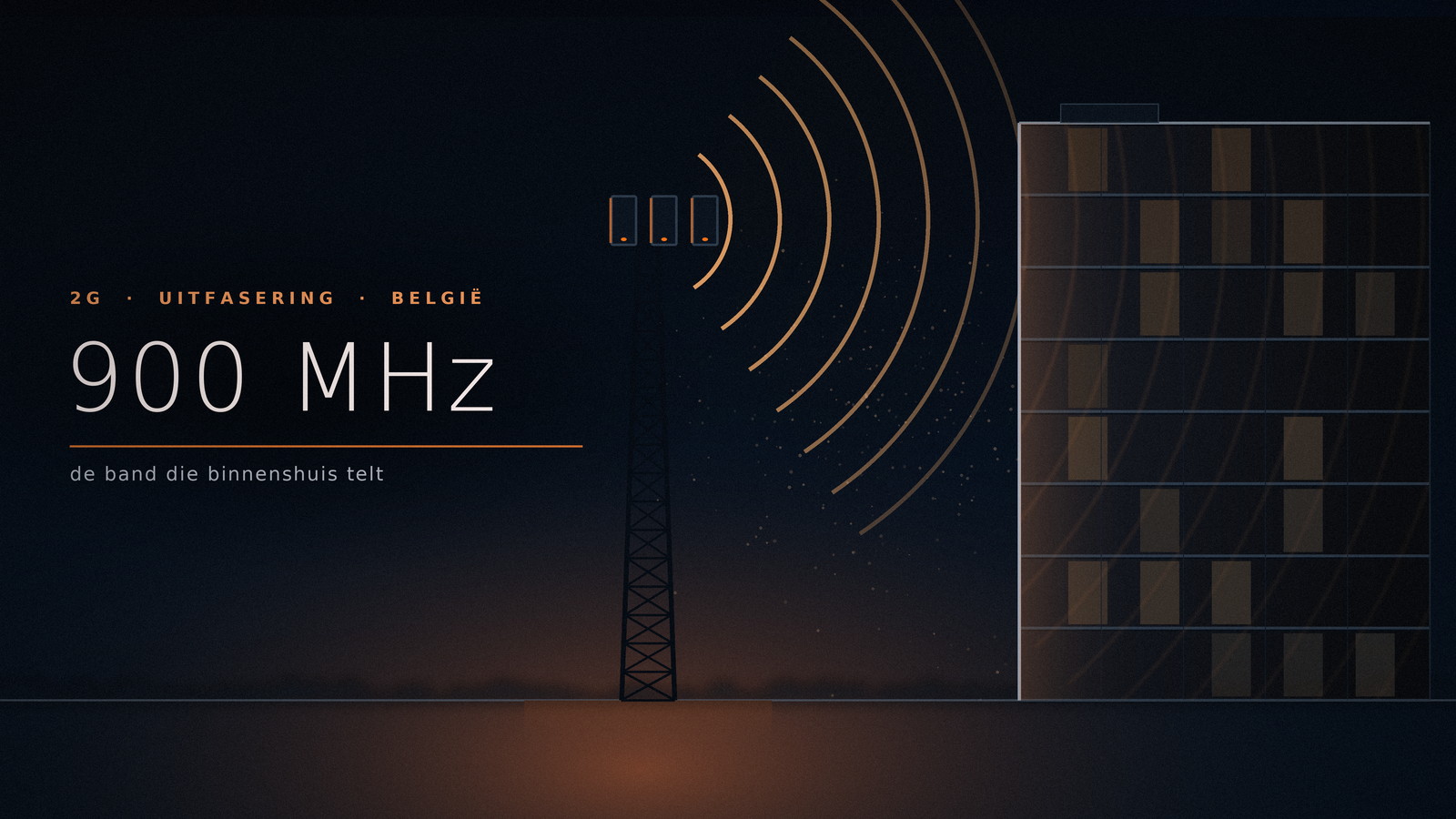
The 900 MHz band is today split between 2G (GSM) and 4G (band B8). As long as 2G keeps running, part of that spectrum must stay reserved for the old technology. Once 2G disappears, that space is freed up entirely for 4G.
Mercuron insight: the space freed up on the 900 MHz band will be used to offer more 4G on the lower bands. Wider channels on a frequency that penetrates buildings well — that is one of the cheapest ways to improve coverage there is.
That is precisely the first reason the BIPT gives for the phase-out: "freeing up more capacity for 4G and 5G". More capacity on a low band means not only more speed, but also a stronger and more stable signal where it is least self-evident: indoors, underground, behind thick walls.
What that means in practice for a building
To make it tangible: this is what remains of a good outdoor signal (−75 dBm) inside a modern, energy-efficient building — double glazing with low-E coating, PIR insulation, reinforced concrete.
- 380 MHz — ASTRID/TETRA: −15 dB attenuation, about 3.2% of the signal left. Voice and ASTRID data work without problems.
- 700 MHz — 5G low-band (n28): −22 dB, about 0.63%. Workable.
- 800 MHz — 4G LTE (B20): −24 dB, about 0.40%. 4G data and VoLTE work.
- 900 MHz — GSM / 4G (B8): −26 dB, about 0.25%. Voice OK, data slow.
- 1800 MHz — 4G (B3): −30 dB, about 0.10%. Marginal, handovers become unstable.
- 2600 MHz — 4G (B7) / 5G (n7): −35 dB, about 0.03%. Unusable without an indoor installation.
Two things stand out. First: every additional 10 dB of attenuation means only a tenth of the signal remains. At 40 dB, barely 0.01% gets through. Second: the gap between 900 MHz and 2600 MHz is almost 10 dB — a factor of ten in received power, through the same wall, in the same building.
That is why it is no detail that 4G will get more room on 900 MHz rather than on the high bands. It is the difference between a signal that reaches the façade and a signal that reaches the façade and gets inside.
But let's be honest: refarming does not solve the physics of your building. A building that attenuates 26 dB at 900 MHz keeps attenuating 26 dB — even with wider 4G channels. A better macro signal helps at the edge of coverage, but an underground car park, a production hall or a new build with triple low-E glazing remains a dead zone without an indoor installation. More signal outside does not automatically mean signal inside.
Who needs to act now?
The phase-out affects more than old phones. The BIPT lists the at-risk groups: personal alarms, alarm systems, lifts with emergency call systems, card payment terminals, certain medical devices for remote monitoring, machine-to-machine applications, IoT devices and eCall emergency calls in vehicles.
And there is a second category that is often forgotten: recent 4G and 5G devices that still fall back on 2G for voice or emergency calls. Not every smartphone sold today can make calls over VoLTE. Without 2G as a safety net, those devices will no longer be able to call after the switch-off — including to the emergency services.
Concrete advice, in order of urgency:
- Check that VoLTE is enabled on every device used within the organisation or family.
- Inventory every 2G-dependent installation in your building: alarm panel, lift telephony, payment terminals, access control, meters, sensors.
- Ask the supplier or installer of each of those systems about 4G compatibility — not only in 2028.
- Actually test emergency calls, instead of assuming they work.
Conclusion: the same band, a better generation
2G has served faithfully for thirty years, but its time has come. The space it leaves behind goes to a technology that does more with the same physics: 4G on 900 MHz, wider and more efficient than ever.
For macro coverage in Belgium, that is an improvement. For your building, it is a good moment to redo the calculation — because the weak spot was never only at the operator. It was also behind your façade.
Mercuron measures, designs and installs indoor coverage for GSM, 4G, 5G, ASTRID and DAB+, whichever generation is running above ground. Have your building measured and know exactly where you stand — before 2028.
Request a free signal analysis →
Sources
BIPT — Shutdown of the 2G networks (updated 16 November 2026), bipt.be. Proximus — "2G is disappearing: what does that mean for you?", proximus.be. Mercuron — Frequency-dependent indoor signal loss (technical study, 2026) and Practical impact per cellular band (2026).