Why your phone says '5G' — but doesn't have the real 5G yet
Roel De Frene
You've probably seen it already: somewhere at the top of your screen it says 5G. You think: great, I'm on the latest generation, speed guaranteed. But when you're in a busy shopping centre, a hospital, or a concrete office building, that 5G promise often falls short. Your phone still shows '5G', while your data crawls or your call stutters.
That's not a bug. It's simply how 5G is built today. And two very different things hide behind that single '5G' label: 5G Standalone (SA) and 5G TDD. They're often confused, but each solves a different problem. In this article we explain it without jargon — using an analogy everyone knows.
First: '5G' is not one thing
Imagine a motorway. You can have a brand-new car (your phone), a brand-new motorway (the 5G network) — but if the old toll booths and traffic lights from the previous generation are still in charge, you'll still be sitting in traffic.
It's the same with 5G. There are two layers:
- The 'brain' of the network — the software and central systems that decide how your phone connects, how quickly it switches, and how reliable everything is. We call this the core.
- The motorway itself — the radio waves and frequencies your phone actually uses to talk to the mast. This is the spectrum.
Your phone can show '5G' perfectly well because it's talking to a 5G mast, while the brain behind that mast is still the old 4G brain. Or it's talking to a 5G brain, but on a frequency that isn't wide enough to be truly fast. Either way: 5G on your screen, but not the full 5G experience.
5G SA: the new brain
SA stands for Standalone. A 5G SA network has a completely new 5G brain. It no longer needs to rely on the old 4G network.
What do you notice?
- Response time (latency). Data no longer has to detour through the 4G system. For applications where every millisecond counts — robots in a factory, remote surgery, self-driving vehicles — the difference is huge.
- Network slicing. The operator can reserve separate 'lanes' of the network. One lane for emergency services that must always work, another for regular users. Useful for hospitals, ports and factories.
- Smarter energy management and better security. The new brain is built for billions of devices at once, not just phones.
In Belgium, operators are working hard on this, but today the majority of 5G connections are still NSA — Non-Standalone. The phone uses 5G radio, but the brain is still largely 4G. That's fine for faster streaming, but it isn't the 5G that factories and emergency services are waiting for.
Important to understand: SA says something about the brain, not about speed. You can have 5G SA and still have slow data if the 'motorway' is narrow. That's where the second half of the story comes in.
5G TDD: the wide motorway
TDD stands for Time Division Duplex. It sounds complicated, but the idea is simple.
Imagine a single tunnel with cars driving in both directions. There's only one tube. To stop them colliding, the tunnel switches direction in turn: first traffic one way, then traffic the other. That lightning-fast switching is called TDD.
Most 4G frequencies work differently: they have two separate tubes — one for each direction. That's called FDD (Frequency Division Duplex). It's neat and predictable, but you're limited to the width of those two tubes.
Why TDD matters so much for 5G: the real high-speed zones sit in the 3.5 GHz band (known as n78 or the C-band). That's the slice of spectrum operators bought for 5G — the widest 'motorway' there is. And that band works with TDD.
In short:
| 5G SA | 5G TDD | |
|---|---|---|
| What is it? | The new 5G brain (software/core) | How the 3.5 GHz motorway is used |
| What does it solve? | Lower latency, slicing, scalability | Much more capacity and speed |
| What do you notice? | Everything reacts faster and more reliably | Peak speeds and large data volumes |
| Where is it? | In the network's central equipment | In the mast and the frequency used |
Real 5G — the kind you see in demos with gigabit speeds and millisecond reactions — only happens when SA and TDD come together. With the new brain and the wide motorway. As long as one of the two is missing, it remains a promise on your screen.
Why you're not getting that speed today
Even with SA and TDD together, there's a third player: physics. And it's ruthless.
The higher the frequency, the more the signal is blocked by walls, glass and insulation. Our own measurements and the literature (ITU-R P.2109) show it clearly: in a modern, energy-efficient building, a 3.5 GHz signal loses as much as 40 dB through a single facade. Only 0.01% of the signal remains. By comparison, the low ASTRID frequency (380 MHz) loses 'just' around 15 dB and gets straight in.
| Frequency | Application | Loss modern facade | Signal inside |
|---|---|---|---|
| 380 MHz | ASTRID / emergency services | −15 dB | −90 dBm (good) |
| 700 MHz | 5G low-band | −22 dB | −97 dBm (fair) |
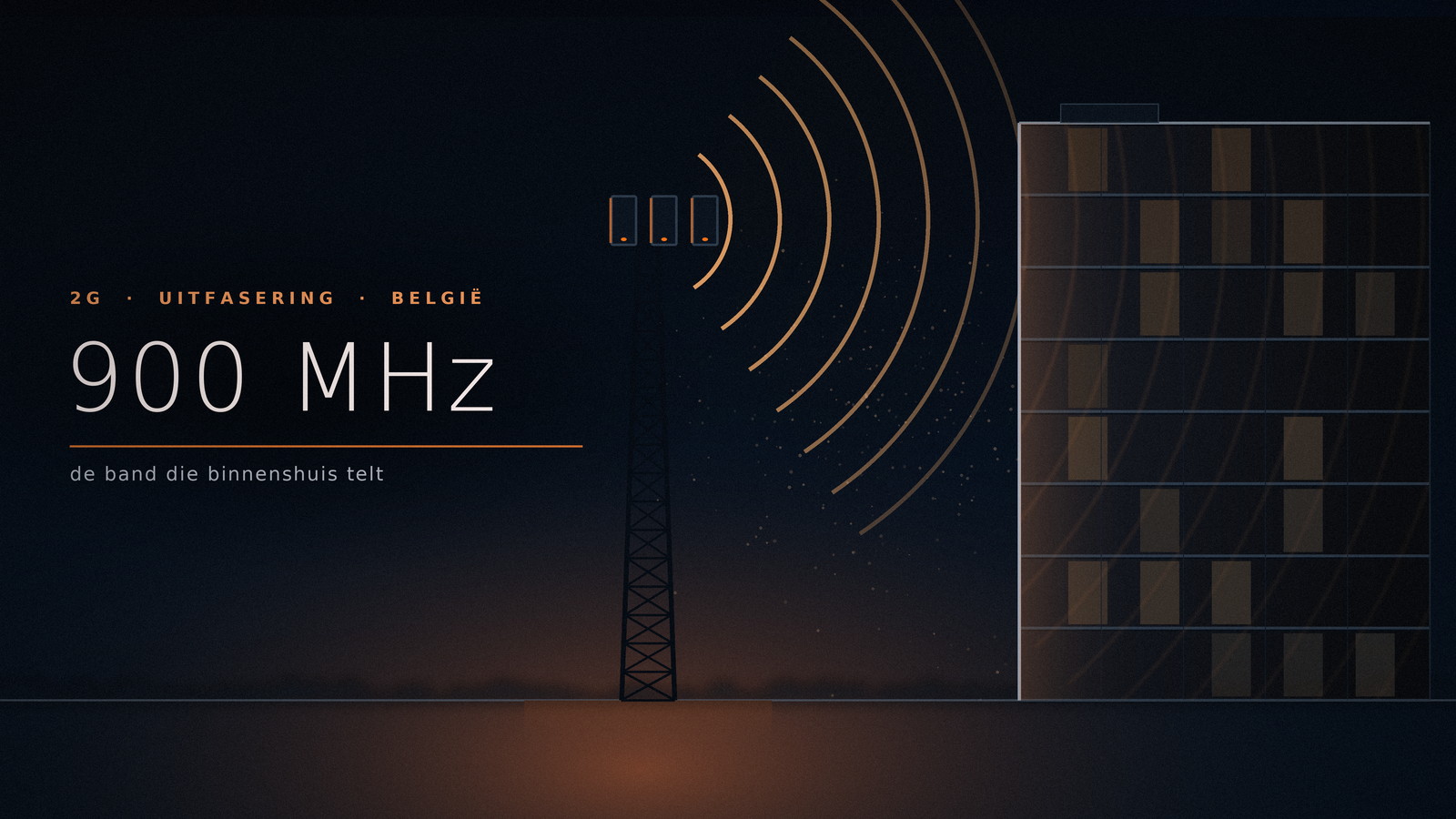
| 900 MHz | GSM / 4G | −26 dB | −101 dBm (limited) |
| 1800 MHz | 4G | −30 dB | −105 dBm (weak) |
| 3500 MHz | 5G TDD (n78) | −40 dB | −115 dBm (unusable) |
Assumption: −75 dBm outside the facade. Source: Mercuron frequency study 2026, ITU-R P.2109-2.
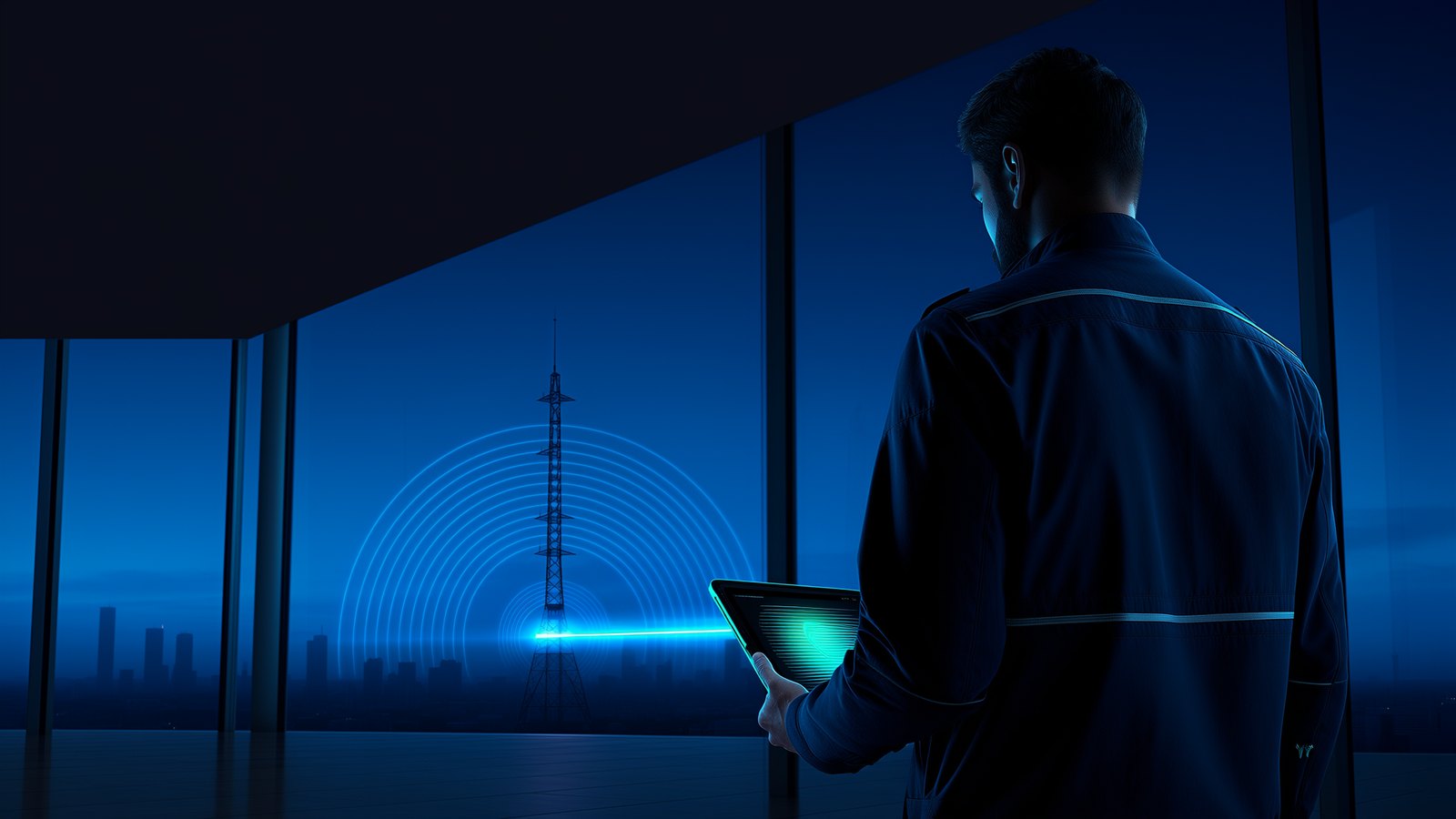
In other words: the widest motorway of 5G is also the most fragile. Outside, in view of the mast, you get enormous speeds. But step inside — a shop, an office, a car park, a factory hall — and that same 3.5 GHz band drops out, leaving your phone falling back to 4G or low-band 5G. Your screen still says '5G', but you're actually on the old, narrow road.
That's why the real 5G promise is currently only delivered outdoors. Even though 80% of all mobile data traffic happens indoors.
What's needed to make the promise come true
Three things need to come together:
- A 5G SA core at the operator — the new brain. This is the step operators are taking now.
- The 3.5 GHz TDD band active and available — the wide motorway. It has already been auctioned and is in use in Belgium, but it isn't built out everywhere with the same density yet.
- Indoor infrastructure — the motorway running through the building. Without active indoor reinforcement (DAS, small cells or repeaters), the 3.5 GHz band stays stuck outside the facade. This is the link that's most often missing today.
That third step is exactly where Mercuron has specialised for years. We build and maintain indoor coverage for ASTRID, GSM, 4G/5G and DAB+ in the toughest buildings: hospitals, tunnels, car parks, factories and logistics halls. The same craftsmanship — RF design, measurements, installation, validation and maintenance — that we apply today to 380 MHz and 700/900/1800 MHz will become increasingly essential for the 3.5 GHz band.
From 2027: Mercuron reinforces 5G TDD indoors
Here's our own roadmap.
From 2027, Mercuron will also be able to reinforce 5G TDD indoors. Concretely: the same turnkey approach you already know from our ASTRID and GSM solutions — from the first measurement campaign and RF design through installation, handover and ongoing maintenance — extended to the 3.5 GHz TDD band.
Why do we do this? Because demand is changing. Companies are investing in private 5G, AGVs, edge AI and camera systems that can't tolerate a shaky connection. Emergency services are moving towards broadband 5G (ASTRID is migrating from TETRA to 5G by 2035). And buildings are becoming more energy-efficient at the same time — and therefore more hostile to radio waves. The intersection of those three trends makes indoor 5G TDD an operational necessity, not a nice-to-have.
For building managers and property owners, this means: the connectivity guarantee you already put in your specification for GSM and ASTRID will soon become a 5G TDD story too. Those who get in early pay for a system ready for the next ten years. Those who wait will face a costly retrofit later — with all the frustration that brings.
In short: 5G SA is the new brain, 5G TDD is the wide motorway. Only when both are present AND the signal makes it inside the building do you get the 5G your screen promised. From 2027, Mercuron handles that last step too: 5G TDD indoors.
Why Mercuron?
- Every frequency, one partner. From ASTRID (380 MHz) through GSM/4G to 5G — and from 2027, 5G TDD indoors too.
- Measurements, not assumptions. Every design starts with an on-site RF measurement. No guesswork, no 'it should work'.
- Turnkey, from design to maintenance. Including validation, documentation and a maintenance contract that keeps your coverage compliant — even three years from now.
- One portal for all your sites. Multiple buildings? Manage them centrally, with status, documents and expiry dates on one screen.
Want to know what 5G TDD can really do inside your building? Have your situation measured. Mercuron provides a concrete assessment — no obligation, based on real numbers rather than promises.