
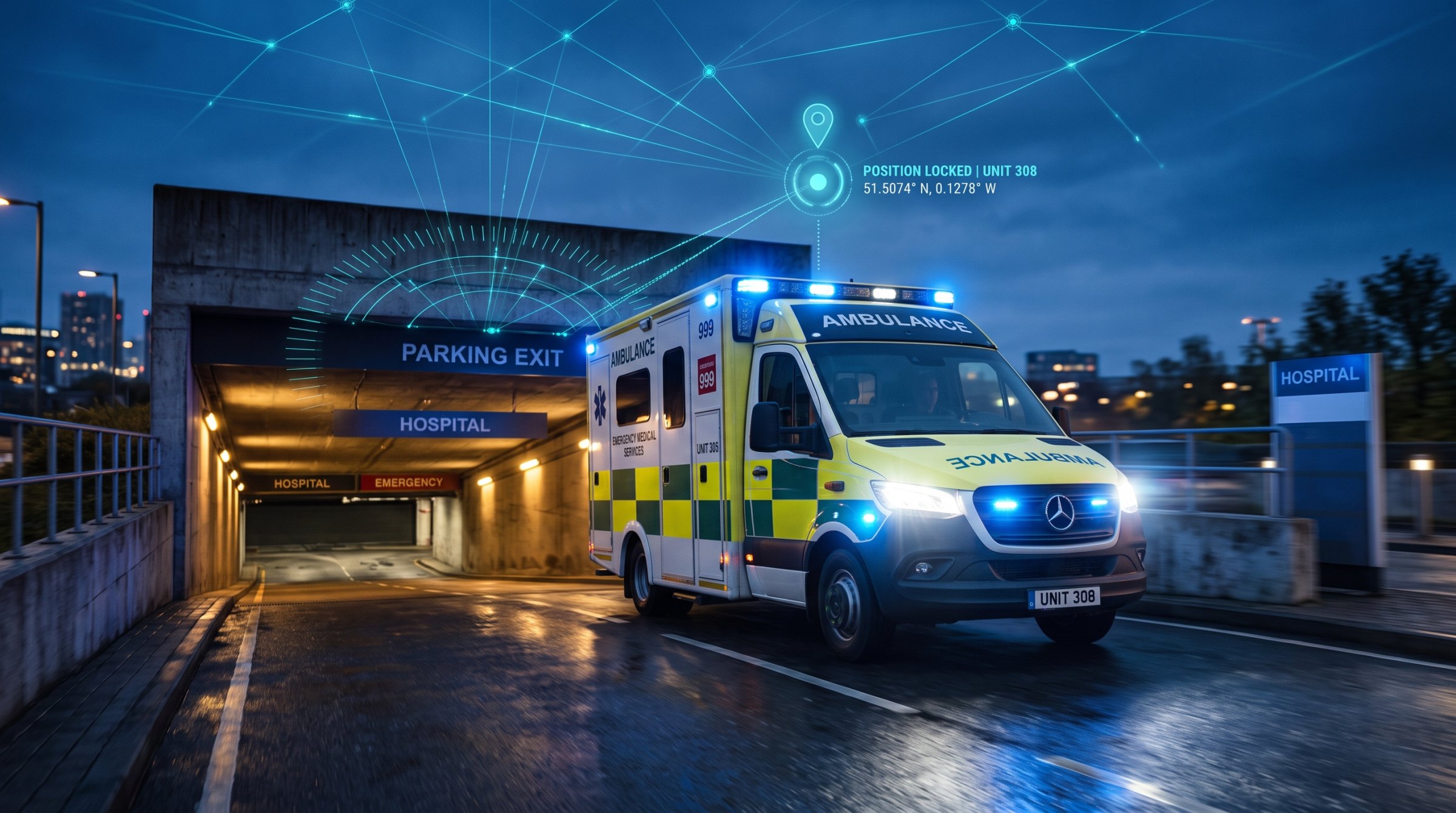
Why an ambulance in the garage has no GPS yet (and how to fix it)
Roel De Frene
Picture this: an emergency call comes in, the ambulance sets off — but on the dispatch screen, the vehicle is still parked in the garage. No GPS fix. Navigation is still searching for satellites while the driver is already on the street. A few seconds, sometimes half a minute. In a cardiac arrest, every second counts.
It's a problem that occurs more often than you'd think, and that few people know about — until it goes wrong. In this post, we explain why vehicles in a garage have no GPS, why that's a real risk for emergency services, and how to solve it.
Why an ambulance in the garage has no GPS
GPS works with satellite signals that come from space — about 20,000 kilometres up. By the time that signal reaches the ground, it is extremely weak. Outside, with a clear view of the sky, that's no problem. But put that same vehicle under a concrete deck, in an underground bay or a shielded dispatch hall, and the signal is gone completely. Concrete, reinforced steel and insulation work together like a Faraday cage.
A GPS receiver that sees no satellites cannot determine a position "a little". It's all or nothing.
The real problem: the "cold start"
When a vehicle without a fix leaves the garage, the GPS receiver has to start from scratch — this is called a cold start. Depending on conditions, that takes tens of seconds to several minutes. Exactly during the critical opening phase of a response: dispatch can't see the vehicle correctly yet, navigation can't calculate a route, and response times are thrown off.
The solution: bring the GPS signal inside
An indoor GPS system (also called GNSS re-radiation) works like this: an outdoor antenna with a view of the sky captures the real satellite signal, a controlled amplifier brings it inside, and a small indoor antenna re-radiates it in the target zone — the garage or the bay.
The GPS receivers in the vehicles receive the same signal indoors as they would outside. So they already build a valid position inside. The moment the vehicle leaves the garage, navigation is active and tracking is reliable. The system re-radiates only the real signal — it does not generate or falsify any position.
Not just for ambulances
Emergency services are the most striking example, but the problem occurs anywhere vehicles need a position before they get outside: fire and police garages, dispatch rooms, logistics and fleet management, underground car parks, workshops and test environments.
Correct and within the rules
GPS re-radiation is technically sensitive and regulated: the signal may only be emitted within the intended zone and must not cause interference outside. At Mercuron, we design every setup with the necessary shielding and tuning, and always discuss the conditions in advance. This is precisely our craft: reliably bringing weak signals into buildings that weren't built for it.
Is your vehicle losing precious seconds in the garage?
An ambulance already located the moment it sets off isn't a luxury — it's time saved where it truly matters. Want to know if indoor GPS is feasible for your garage or dispatch? Request a no-obligation analysis. We'll assess the zone, the vehicles and the possibilities — without costs or obligations.